Upload + hash
Accept the file, compute its identity, and check the local cache before spending another call.
Applied research · personal project · ongoing
An inspectable malware-triage agent for Windows executables. It gathers static evidence, chooses the next bounded tool from what it has learned, and keeps uncertainty visible all the way to the report.
The “agent with tools” metaphor is a visual map of the real system. Every arm returns a typed artifact; none of them detonates the sample.
01 · The contract
MalWhere is not an unconstrained “ask an LLM about malware” demo. Every run begins with identity and static evidence, then allows the agent to decide which additional tools are worth calling. The report stays grounded in returned artifacts and can say unknown when the evidence is inconclusive.
Accept the file, compute its identity, and check the local cache before spending another call.
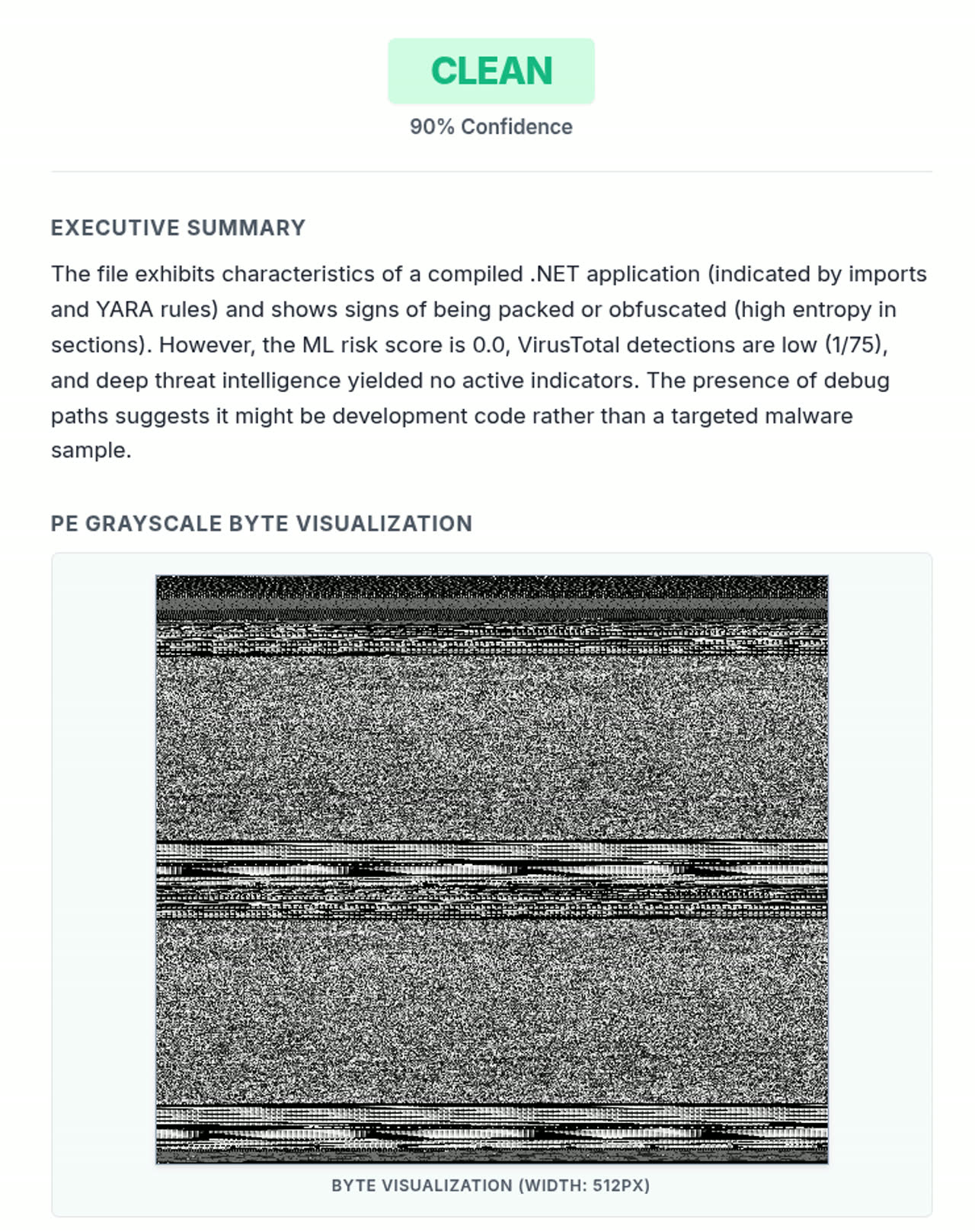
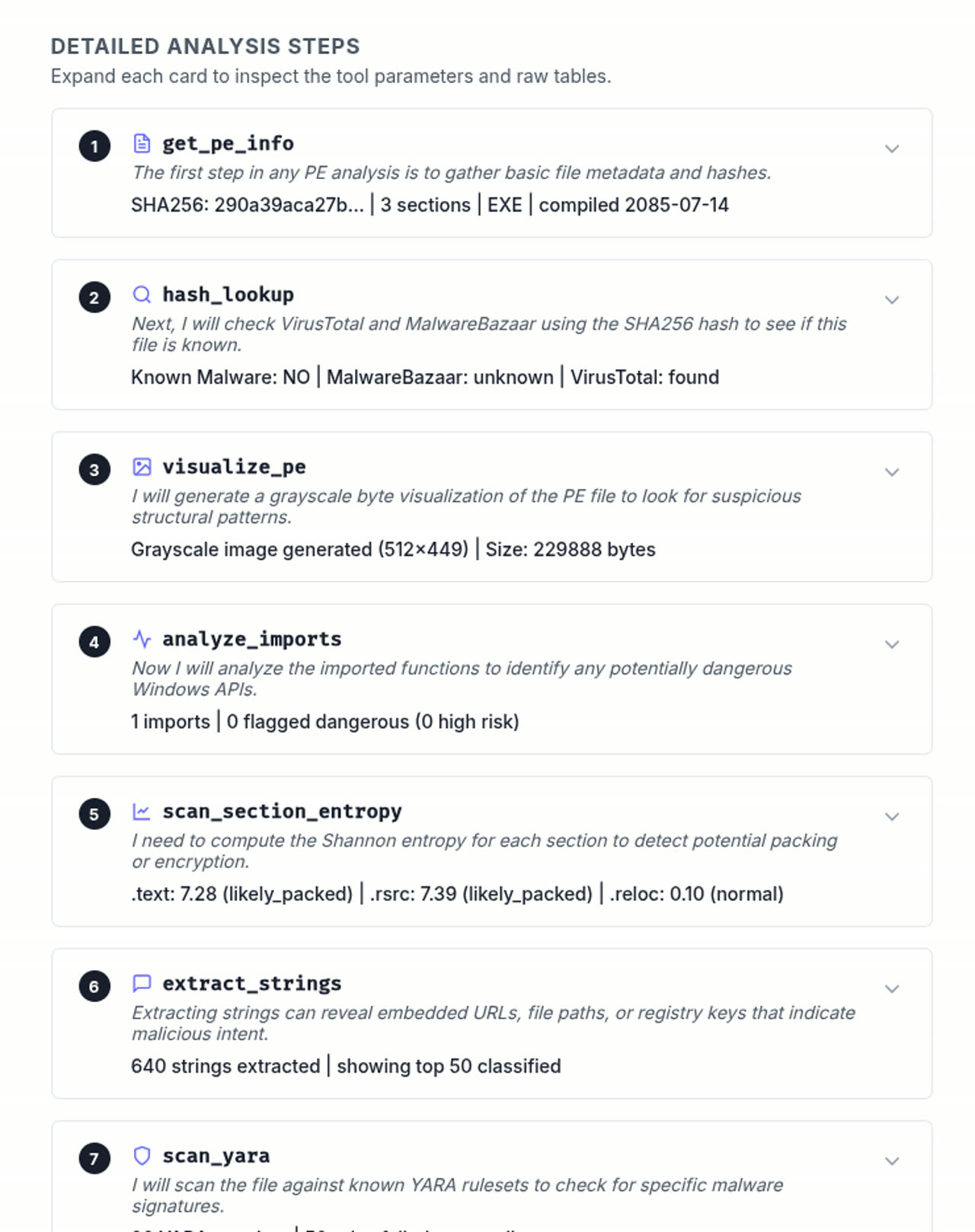
PE metadata, imports, entropy, strings, YARA, and a byte visualization expose different surfaces.
The ReAct loop selects threat-intelligence or model tools from intermediate findings.
Contradictory, missing, and positive signals remain visible beside the agent’s rationale.
A bounded run ends in a verdict, trace, or explicit failure state rather than a silent stall.
02 · Tool system
Each tool is deliberately narrow. The model chooses among typed capabilities, while the application owns caching, timeouts, JSON repair, heartbeats, and cleanup.
Infrastructure around the tools: an SQLite hash cache avoids repeated work while the application owns timeouts, repair, heartbeats, and cleanup.
03 · Evidence artifacts
The frontend receives the investigation over server-sent events. A heartbeat keeps long-running work alive; background execution, cleanup, and cache hits keep the interface honest even when a tool is unavailable.
Numerical and structural clues stay attached to the file instead of being flattened into a single opaque score.
A learned classifier contributes one signal among several, with its threshold and evidence context visible.
The byte image is a readable artifact for the operator, not a claim that the language model has verified visual perception.
04 · Boundaries
Hashes and caches samples, parses PE structure, computes entropy and strings, checks YARA rules, scores with EMBER, renders bytes, and conditionally queries VirusTotal or MalwareBazaar.
There is no sandbox, detonation, process execution, dynamic behavior capture, or claim that static evidence is a definitive verdict. The product communicates that boundary to the operator.
05 · Investigation output
Every completed case exposes the sample identity, the tools called, their typed results, the evidence synthesis, and the final confidence. An analyst can inspect the chain without opening source files or reconstructing the run from logs.
The report begins with stable sample identity, PE properties, cache status, and the exact static-analysis boundary.
Tool requests, returned artifacts, failures, and recovery remain ordered so the next decision has visible context.
The synthesis cites the signals that support it and leaves unknowns explicit instead of forcing false certainty.